In 2026, the European Week for Waste Reduction (EWWR) focuses on Material Sufficiency — a powerful approach to reducing waste by rethinking how much we consume, what we truly need, and how we organise our systems of production and consumption.
Sufficiency is about ensuring wellbeing for all while respecting planetary boundaries. It challenges us to move beyond managing waste and instead prevent it at its source.
Watch this ADEME video, which presents the concept of sobriety at the territorial scale and explains it through concrete examples across different areas: mobility, urban planning, tourism, water, buildings, digital technology, and consumption. The video is in French, but you can enable YouTube subtitles in your language.
What is sufficiency
The IPCC defines sufficiency as policies, measures and everyday practices that reduce the demand for energy, materials, land and water — while delivering human wellbeing for all within planetary boundaries. In simple terms, sufficiency means: Focusing on what we truly need to live well and organising our societies to meet those needs using fewer resources.
Sufficiency places wellbeing at the centre. It asks not only how efficiently we produce and consume, but also how much is enough.
Sufficiency focuses on the needs of people and thus on wellbeing. By prioritising the amount, level, and nature of goods and services that require resources, sufficiency is different from efficiency, which is concerned with reducing the relative amount of resources needed to provide a given good or service by technological solutions. Services and work-places closer to homes, an adequate public transport infrastructure accessible and affordable for all, vehicle sizes adapted to needs, shared building spaces and a more efficient living space distribution that avoids both over- and under-occupation, better-quality clothes, longer-lasting products, more plant-based food and decent access to drinking water for all, all have to do with sufficiency. Such changes require adequate policies. (Source: Sufficiency Manifesto)
Why sufficiency matters now
The Circular Economy has driven important progress in sustainable resource management. However, many initiatives still focus on optimising existing systems, based on a traditional linear economy, rather than reducing overall material demand. If waste prevention is not prioritised, we will not reach the targets to keep humans’ emissions within the planet boundaries. Recycling alone cannot compensate for continuously growing consumption levels.
A sufficiency-based Circular Economy shifts the focus upstream:
- Preventing waste before it is created
- Reducing unnecessary production
- Designing systems that meet needs with fewer materials
QUESTION our choices, VALUE our resources!
Material sufficiency means redefining prosperity, which is far from asking for sacrifice or making all of us unhappy. It means:
- Services and workplaces closer to homes
- Accessible and affordable public transport
- Vehicle sizes adapted to actual needs
- Shared spaces
- Better distribution of living space
- Durable, high-quality products
- Repairable goods
- More plant-based food options
- Access to safe drinking water for all
The European Week for Waste Reduction challenges its community to adopt the sufficiency principle to rethink choices and behaviours, but also infrastructure and public policies, reaching the fair consumption space, where humans flourish while planet boundaries are respected to reach climate stability.
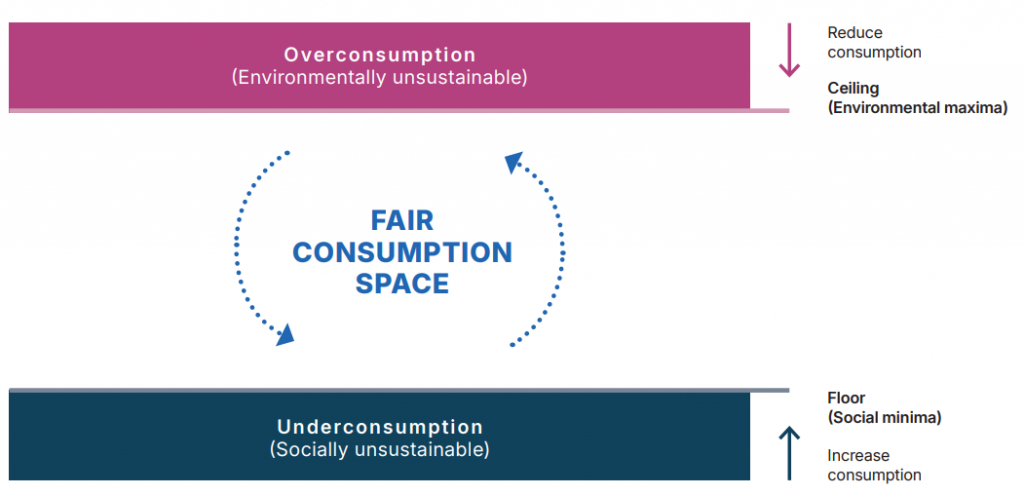
Source: A Climate for Sufficiency by Hot or Cool Institute
Join the EWWR
Material sufficiency is about redesigning our systems to ensure fairness, resilience and sustainability.
Thousands of actions across Europe already demonstrate that living well with fewer materials is not only possible — it is desirable.
Get inspired.
Organise your action.
Contribute to a resource-wise and climate-resilient Europe.
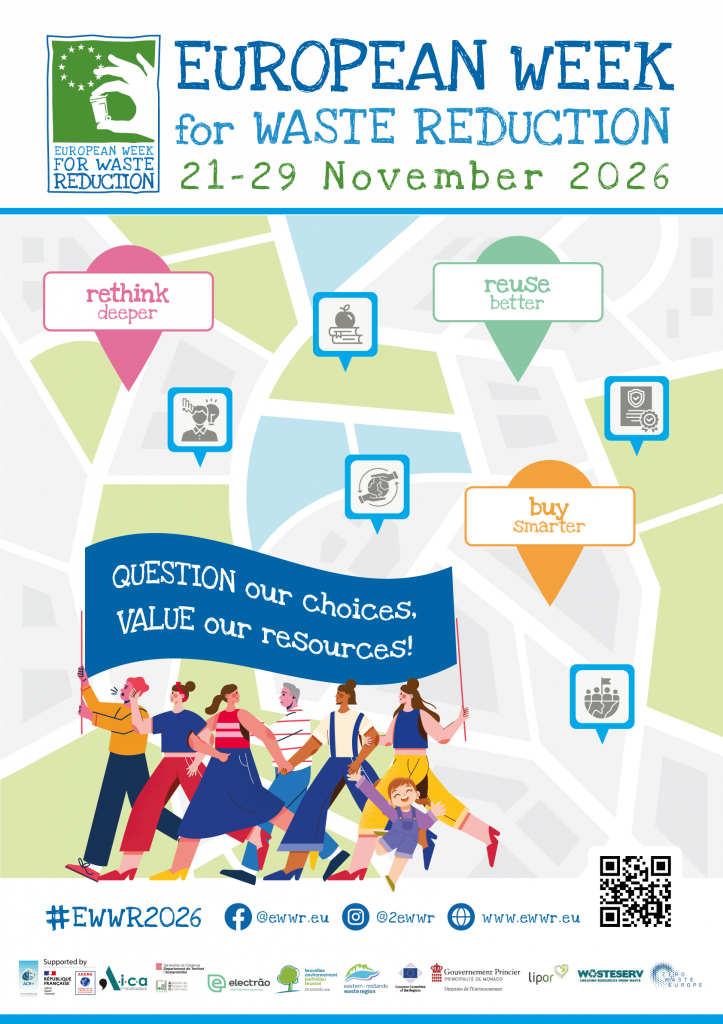
You can download below the EWWR 2026 thematic poster. Use it to inspire others to take action for the EWWR! It is available in Dutch, English, French and Portuguese.
Get inspired
What does sufficiency look like in practice?
EWWR 2026 invites you to turn sufficiency into action through four key areas:
- Shared Economy: Promote sharing over ownership. Many are the occasions during which you don’t need to own an item in order to appreciate and enjoy a specific activity and experience. You could borrow it from a friend, or rent it from a shared service provider, and public authorities could arrange a library of things in their city.
- Reuse: Extend the life of products through reuse systems and redistribution networks. From the most common solution of reusable cups and packaging to the treasures hidden in the reuse facilities, of course considering also the second-hand markets in their totality, for textiles, furniture, electronic devices, etc.
- Repair: Support repair culture, skills and infrastructure to keep products in use longer. Public authorities at all levels are called to promote and support repair businesses and activities, with an obligation for products such as personal and household electronics. But also manufactures need to make information on repair easily accessible.
- Designed to last: Encourage durable, repairable and modular product design. A change on how products are designed is needed to reduce the resources needed during the production process and to make items last longer. Many are the sustainable alternative solutions our there. Whenever a new items is truly needed, opting for a repairable, and designed to last option should be the preferred choice.
Thousands of initiatives across Europe are already demonstrating that sufficiency is practical and enjoyable but also beneficial not only environmentally, but socially and economically. Now it is your turn. Get inspired by the EWWR and share your actions to reduce the use of material resources not at the expenses of happiness, comfort and efficiency.
The section below collects recommendations and inspiring ideas to apply this new mindset for all the 5 EWWR categories.

ARE YOU A PUBLIC AUTHORITY?
Public authorities play a crucial role in shaping infrastructure, regulations and public procurement systems. You can lead by example and support resource-wise approaches:
- Integrate sufficiency criteria into public procurement
- Develop waste prevention strategies for large events
- Support local reuse and repair centres
- Promote shared public infrastructure and services
- Encourage efficient use of public buildings and spaces
Prevent waste in large events
The impact of large events on resource consumption is beyond any doubt. Their number and footprint make it essential to introduce sustainability as a criterion in their organisation. Although there are several factors that come together to make an event more sustainable, in practice one of the most relevant is the generation of waste and its management. There are an increasing concern and commitment on the part of regional and local administrations to make the large events organised in their territories greener, with private stakeholders also being increasingly committed to sustainability, as well as the participants of those events. However, the many aspects involved makes the challenge is often beyond the capabilities and resources. This is why the cities of Klaipeda, Krakow, Bologna, Malaga and the region of Central Macedonia in Greece came together to explore this field and identify good practices.

ARE YOU A PRIVATE ENTREPRENEUR?
Businesses are key actors in reducing material use and reshaping consumption patterns. Sufficiency creates opportunities for innovation by focusing on durability, service-based models and customer trust. You can:
- Develop product-as-a-service models
- Offer repair and maintenance services
- Design long-lasting products
- Reduce packaging and material intensity
- Facilitate second-hand or refurbishment systems
- Educate customers on sustainable use
Be a sustainable SME in the touristic sector
As tourism SMEs are facing an increasing demand in more sustainable accommodation and hospitality services from tourists, as well as their local and regional authorities, which they want to meet, research show that the level of knowledge or skills often hamper these improvements. The TouriSME project, funded by the European Union’s European Innovation Council and SMEs Executive Agency, gathered more than 60 SMEs from some of Europe’s leading tourism destinations – Spain, Italy, France and Cyprus, to offer them capacity building, study visits and other learning opportunities. This publication contains some 106 good practices coming from various SMEs in the tourism sector.
Activate sustainable behaviour in your fans
Sport organisations have a significant potential to influence certain behaviour, patterns and processes in multiple ways and from different angles – from the way they operate daily and organise events, the choices and new principles they put in front of their followers, fans and visitors and most importantly – the way the collaborate with their local and regional authorities. The increasing trend in “greening” sports is evident and many sport organisations are putting forward various strategies and roadmaps revolving around sustainability, and environmental management – spanning across various aspects such as waste management, biodiversity, food and beverage management, energy and water management and much more. The ACCESS project, with the Danish and Welsh FAs, FC Porto and GAA, wanted to narrow down the gap between the efforts of sport organisations and the targets and priorities of their local authorities and make sports contribute more to the bigger picture and to the well being of the local communities.
ARE YOU A NOT-FOR-PROFIT PROFESSIONAL?
NGOs and civil society organisations are powerful drivers of behavioural and systemic change:
- Raise awareness about sufficiency and waste prevention
- Organise repair cafés, swap events and sharing initiatives
- Support vulnerable communities through redistribution networks
- Advocate for policy frameworks that prioritise prevention
- Facilitate dialogue between citizens, businesses and authorities
By building community-based solutions, you help make sufficiency tangible and inclusive.

ARE YOU AN EDUCATOR?
Education is essential to shaping long-term change:
- Integrate sufficiency and waste prevention into curricula
- Organise hands-on activities (repair workshops, upcycling labs, sharing projects)
- Encourage critical thinking about consumption patterns
- Promote school-wide waste prevention strategies
- Engage students in EWWR actions
Empowering young people with the knowledge and skills to rethink material use is one of the most effective long-term strategies for change.
ARE YOU A CITIZEN?
Everyday choices matter and collective action amplifies impact:
- Buy only what you truly need
- Choose durable and repairable products
- Repair before replacing
- Borrow, share or rent instead of owning
- Support second-hand markets
- Reduce food waste
- Participate in local EWWR actions
Sufficiency does not reduce quality of life, on the contrary, it enhances it by focusing on what truly brings value and wellbeing.