
Consumption of textiles has, on average, the fourth highest impact on the environment and climate change in the European Union, after food, housing and mobility. It is also the third highest area of consumption for water and land use, and fifth highest for the use of primary raw materials and greenhouse gas emissions.
Textile consumption in the European Union increased from 17 kg per person in 2019 to 19 kg per person on average in 2022 — enough to fill a large suitcase with new textiles. At the same time, around 12 kg of clothing per person is dumped each year in the EU – equivalent to 5 million tonnes.
Textiles are one of the biggest sources of PFAS pollution in Europe. Polyfluorinated alkyl substances (PFAS), a group of highly persistent chemicals, are widely used in many textile-based products including clothing, carpets and other household goods for waterproofing, oil, dirt and heat protection, and increased durability. Reducing the use of PFAS – known as forever chemicals – in clothing, furniture and other textile products, is important to increase recyclability and the transition to a more circular economy.
It takes a lot of water to produce textile, plus land to grow cotton and other fibres.
To make a single cotton t-shirt, 2,700 litres of fresh water are required according to estimates, enough to meet one person’s drinking needs for 2.5 years.
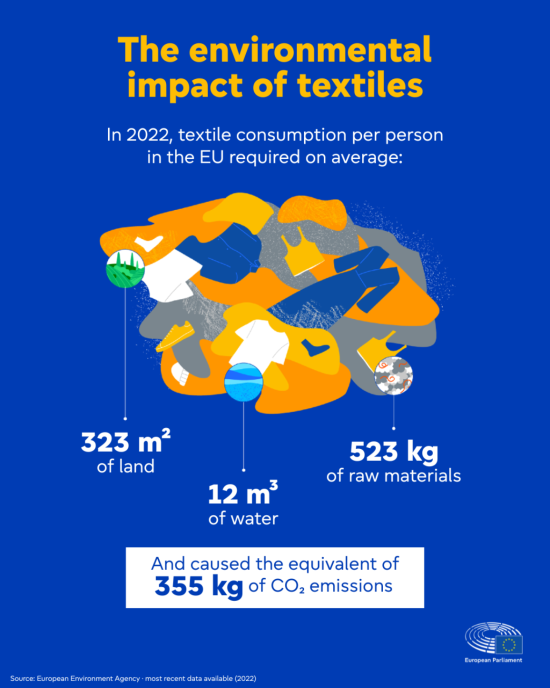
In 2022, textile consumption per person in the EU required on average:
- 323 square metres of land
- 12 cubic metres of water
- 523 kg of raw materials
According to the European Environment Agency (2024), between 4% and 9% of all textile products put on the European market are destroyed without ever being used. Used clothes can be exported outside the EU but are mostly (87%) incinerated or landfilled.
The way people get rid of unwanted clothes has also changed, with items being thrown away rather than donated. Less than half of used garments are collected for reuse or recycling, and only 1% of used clothes are recycled into new clothes, since technologies that would enable clothes to be recycled into virgin fibres are only now starting to emerge.
Why is prevention key to reducing the environmental impact of textile waste?
Prevention is key to reducing textile waste because it is the most effective way to mitigate the problem. A vast number of textiles (carrying a massive environmental burden) are created every year, but many of these are never fully used.
Researchers from Belgium and the Netherlands found that 22% to 50% of the clothes in a typical European wardrobe are “dormant” – meaning they have not been touched or worn a single time in the last 12 months. Of these dormant items, 75% are still in good enough condition for reuse, but study participants were unwilling to part with almost 60% of these items, mainly due to future-use intentions – the notion that they will wear those clothes eventually. Likewise in Britain, according to WRAP, people have 118 items of clothing in their wardrobes on average, but 31 have not been worn in the past year. That’s a quarter of wardrobes sitting unworn.
Not only have they cost money to buy, but at some point, these clothes will become waste. That means that avoiding the purchase of this dormant quarter of our wardrobes in the first place would save money and prevent waste – at no detriment to the wearer.
The problems of textile waste are also exacerbated by online shopping. Since e-shoppers cannot try on the items before they buy online, some tend to purchase the same product in different sizes to try on at home. This often results in them returning or, in some cases, even throwing away the products that do not fit. Lenient return policies have led to an increase in returns, of which 22% to 44% never reach a new customer and are instead destroyed.
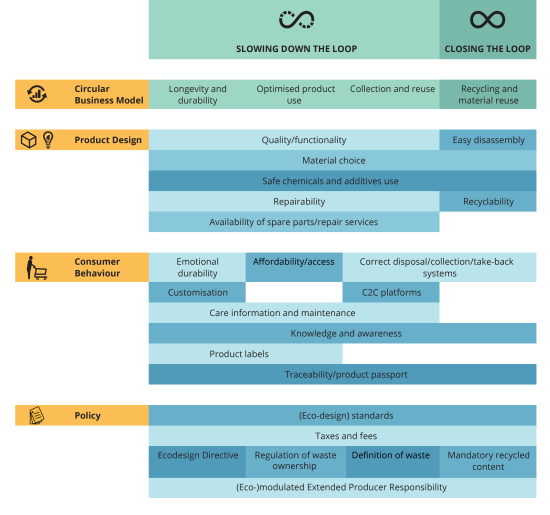
Circular design is an important enabler of the transition towards sustainable production and consumption of textiles through circular business models. The design phase plays a critical role in each of the four pathways to achieving a circular textile sector: longevity and durability; optimised resource use; collection and reuse; and recycling and material use.
Why is textile waste a relevant stream to move towards a circular economy?
According to the European Environment Agency, the textiles sector is the third largest employer worldwide, after food and housing. In 2020, almost 13 million workers were employed in the global supply chain to fulfil the European Union’s demand for clothing, textiles and footwear alone.
Textiles are also an important economic sector for the EU’s domestic economy. In 2019, this sector had a turnover of EUR 162 billion, employing over 1.5 million people across 160,000 companies. Around 6.9 million tonnes of finished textile products are produced in the EU-27 every year. Production specialises in carpets, household textiles and other textiles (including non-woven textiles, technical and industrial textiles, ropes and fabrics). In addition to finished products, the EU produces intermediate products.
Becoming more circular is crucial to reducing the environmental and climate change impacts of the textiles industry. Implementing and scaling up circular business models requires technical, social and business model innovation; as well as enablers from policy, consumption and education.
How can textiles become more circular?
There are four main pathways to realising a circular economy for textiles. But they all start with design, which is the cornerstone that can ensure higher quality of materials, longer lifetimes, better use of materials, and stronger options for reuse, repair, and recycling. Better design is a life-extending strategy that avoids inefficient waste management decisions and enables higher waste hierarchy strategies to take place.
The first pathway from circular design is to ensure the longevity and durability of textile products. Fast-changing fashion trends and a decrease in product quality have reduced the life span of clothes by 36% in two decades, according to the Ellen MacArthur Foundation. Careful selection of materials is important because one of the biggest drivers of textile waste by consumers is dissatisfaction with a product’s functionality, such as rips or holes, worn-out appearances, loss of shape, stains or colour fading. Design can also make or break possibilities for repair, with well-designed items enabling at-home or simple repairs.
The second pathway from circular design is to optimise resource use. For companies, this can mean reducing the material, water, and energy used to create a product, or changing the input of materials to allow more recycled fibres. Some companies offer clothing subscription services, in which customers pay a fee to rent a specific number of garments. This allows them to change their wardrobe frequently, without acquiring new clothes.
The third pathway concerns the collection and reuse of textiles. Since January 2025, EU countries are required to collect textiles separately for re-use and recycling. In September 2025, the European Parliament approved new rules under which EU countries should set up Extended Producer Responsibility (EPR) schemes that would make sure producers of clothing, accessories, hats, footwear, blankets, linens, curtains (and optionally mattresses), cover the costs for collecting, sorting, and recycling their products. These EPR schemes should also cover products sold online or by producers registered outside the EU. These legislative changes encourage new business models to emerge and make the economic case for circular textiles. For examples, some brands and retailers have introduced take-back services and pre-loved collections, while online platforms for buying and selling clothes are increasingly popular.
While the previous pathways focused on “slowing down the loop”, the last pathway “closes the loop”: recycling and material reuse. This means turning waste textiles into raw material for new textiles or other production chains. Material can be reused at the fabric level through remanufacturing, often referred to as “upcycling”, or at the fibre level through recycling. Both reduce the need for virgin raw materials and textile waste generation.
the problem
Textile waste
Learn More
- Close the loop, a guide towards a circular fashion industry.
- Quiz on consumer’s behavior (in French)
- Textile action Network, uses the principles of a circular economy to re-shape the production, consumption, and disposal of textiles.
- Love Your Clothes’ campaign aims to raise awareness of the value of clothes and encourage people to make the most of the clothes they already have.
- The Share and Repair Network is a Scottish initiative to help local communities reduce consumption by offering sustainable and affordable alternatives to buying new. Find Sharing Libraries that allow customers to borrow an item instead of buying one new and Repair Projects to help customers to fix an item, instead of throwing it away!
- Textiles Resource Hierarchy – Prevention (WRAP – The Waste and Resources Action Programme)
- Circularity of the EU textiles value chain in numbers – Publications | European Environment Agency (EEA)
- Textiles and the environment: the role of design in Europe’s circular economy – Publications | European Environment Agency (EEA)
- Redefining used textiles and textile waste (EEB)
- Unsustainable fashion and textiles in focus for International Day of Zero Waste 2025 (UNEP)
- Five ways to reduce waste in the fashion industry (UNEP)
 Associação/ONG
 Negócios/Indústria
 Estabelecimento Educativo
 Cidadão(ões)
Organise a swap event
A t-shirt that you don’t like or that doesn’t fit you anymore could find a new home and extend its life. Engage your colleagues, friends, family in a swap event. The rule is one: everyone brings some cloths that are waiting since too long in the wardrobe unworn. And do not forget the good spirit and vibe to give a second life to a piece of textile.
 Administração/Autoridade Pública
Boost repair in your city
Engage your community in choosing to repair their cloths instead of throwing them aways and buying new. Give visibility to all the businesses and associations that give this service in your city, by creating a website page where you list all of them but also the repair cafès events! And what about mapping them
Administração/Autoridade Pública
Associação/ONG
Raising awareness with movies
Images speak more than thousands of words, right? Especially when it’s about the impact of textile in our society and environment. Organise a live screen of a documentary on textile in a park or in the main square of your city. Do you need suggestions on the movie?
We made a very good selection in our toolbox.
Cidadão(ões)
Make your book club or podcast circular!
If you are already part of a book club or you are thinking to launch one, which better moment to focus the book of November on the impact of textile and how we can make the difference? We have made a selection of key books to be read on this topic! Check our Toolbox!
If you are more into podcasts, here is our selection but we look forward to listening to yours! What about focusing the episode of the Week on waste prevention?
Administração/Autoridade Pública
Associação/ONG
Negócios/Indústria
Cidadão(ões)
Estabelecimento Educativo
Circular fashion show
Hit the runway with a collection of circular garments in a sustainable fashion show! Citizens, associations, businesses, or schools can organise a competition for local or young designers to create a series of outfits using only repurposed clothing.
For inspiration, check out the video of the Action “Re-viste tu Mente” organised by the Provincial Council of Álava, EWWR finalist in 2025 for the public administration category, or the Eco Fashion Competition, organised by Lisburn Castlereagh City Council and South Eastern Regions College, finalist for the public administration category in 2022.
Estabelecimento Educativo
Cidadão(ões)
Play with words
The EWWR identified 10 key words that we all should know about to embrace a circular transition for textiles. Going from Microplastic, to Fairtrade textile, until Fast Fashion, 2 games have been produced that you can use to engage your students or kids.
Download the material and organise the offline Find the couple game, or the online Team competition game!
Administração/Autoridade Pública
Bulky textile waste awareness campaign
Public authorities need to be very careful about bulky waste. If not collected properly, it can create big social and environmental problems as well as large costs. Mattresses, furniture, carpets, and other large textile items can be considered as bulky waste. To educate citizens about this waste & how to deal with it, public authorities can launch an awareness campaign. This can be presenting bulky waste in a public space in an eye-catching and creative way, launching a digital communication campaign, accompanied always of course by information. Better still, pair your awareness campaign with a special month where the public authority increases its availability to collect bulky waste.
Get inspired by the action “Con los voluminosos, no seas delincuente”, organised by Residuos de Navarra in 2025. Check their video.
Cidadão(ões)
Upcycle challenge
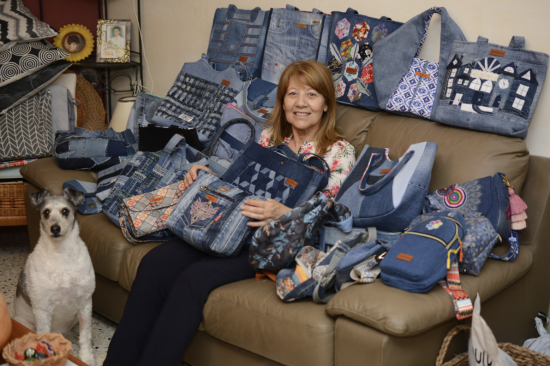
Put your handcraft skills to work and create new objects from old textiles. Those old trousers that don’t fit anymore? Old jackets you never wear anymore? Get out the fabric scissors and sewing needles and turn them into a bag or quilt!
See the 2025 EWWR Award finalist in the Citizen category, “Recycling clothes”, for more inspiration!
Administração/Autoridade Pública
Associação/ONG
Estabelecimento Educativo
Clothing repair marathon
Challenge your community to come together for a clothing repair marathon. Arrange a dedicated crew of sewers and seamsters to help people repair as many clothes as possible on one day. Use the opportunity to run workshops for young people and kids, or collaborate with a local fashion school to help run it.
Administração/Autoridade Pública
Associação/ONG
Cidadão(ões)
Circular textiles, climate canopy!
Across southern Europe, more and more public authorities are turning to textiles to mitigate heat stress and contribute to climate change adaptation. Transform old clothes or scrap textiles and leftover yarn into a beautiful canopy to hang over the public street, like they’ve done in Alhaurín de la Torre, Spain. Not only does this reduce the urban heat island, it also adds beauty to the streetscape, fosters citizen involvement, and raises awareness about the second life of textiles.
Organise your EWWR action! Get inspired by the following ideas for actions on textile waste
Cidadão(ões)
Estabelecimento Educativo
Associação/ONG
Negócios/Indústria
Administração/Autoridade Pública