Food waste indicates all the food (including drink) and associated inedible parts removed from the human food supply chain in the following sectors: manufacturing of food products, food/grocery retail, food service, and households.
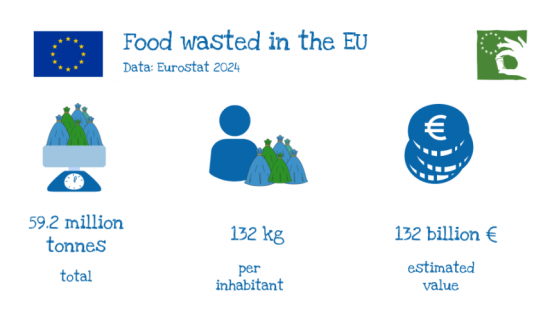
Every year, the EU states produce over 59.2 million tonnes of food waste, which corresponds to 132 kg per inhabitant. This data is even more dramatic if we consider that over 37 million people can’t afford a quality meal every second day.
At global level, one third of all food produced for human consumption is wasted. Looking at the UNEP data, in 2019 around 931 million tonnes of food waste have been produced, counting as 17% of the total global food production. But at which moment is this food becoming waste? The big majority of the food waste is produced in the households (more than a half of the food waste produced), in food service (restaurants, catering) and in retail (supermarkets, shops).

Behind this amount of food waste, both economic and environmental impacts are hidden. Data estimates that for the food waste produced yearly in Europe, there’s an associated market value of 132 billion euros. Furthermore, food waste has consequences in terms of Greenhouse Gas Emissions related, for instance, to the use of cropland, freshwater resources, and fertilizers for food production.
Why is prevention key to reducing the environmental impact of food waste?
Preventing food waste has huge environmental, social, and economic benefits. Food waste is responsible for 8-10% of global Green House Gas (GHG) emissions and uses an estimated 28% of the world’s agricultural land, an area larger than China and India combined. This land could otherwise enhance food security, nature restoration, and biodiversity. To meet its 2030 climate goal of a 55% reduction, the EU must double its pace in reducing greenhouse gas emissions, and food waste reduction plays a key role as it represents approximately 15% of the total GHG footprint of the EU’s food system.

Moreover, over 37 million people in the EU cannot afford a quality meal every second day, while globally, wasted food could feed 1.26 billion hungry people every year. This makes preventing food waste not only a moral imperative but also an economic incentive to save money for farmers, companies, and households. In fact, wasting food costs EU businesses and consumers an estimated €143 billion a year. Preventing food losses and waste is hence a win on multiple fronts: for our climate, biodiversity, food security, business revenues, and household budgets.
Why is food waste a relevant sector to move towards a circular economy?
Several factors contribute to food waste in the supply chain: aesthetics standards preventing not perfect food from being harvested or sold, damage during transport and storage, long supply chains, standardised packaging sizes, and regular store shelf replenishment. Consumers also contribute by misunderstanding date labels, overbuying food, or lacking proper storage and cooking skills.
Addressing those diverse causes requires multi-level interventions; key measures include, for example, greater cross-supply chain cooperation, shortening supply chains, ensuring all food gets harvested, avoiding oversized portions in restaurants, improving date labelling, avoiding standardised packaging, supporting food donations, and raising consumer awareness about better food preservation. Numerous large manufacturers are already leading the way, achieving waste reductions of 30%, 40%, and even 50% by 2030. Governments must stimulate food waste prevention at all levels, and EU-wide legally binding targets can guide the way and ensure every country is doing its fair share of the challenging task ahead.
the problem
Déchets alimentaires
Learn More
- The FOODRUS project provides interesting results and materials on 3 demonstration sites that reduced food loss in the production value chain: Danish pilot on meat and fish, a Slovakian pilot on the bread value chain, a Spanish pilot on vegetables and prepared salad. Check the videos available with English subtitles here.
- Food waste in Europe: facts, EU policies and 2030 targets. Food waste costs the EU over €130 billion each year and affects millions of households. Find out the causes, the impact and the EU actions simply explained
- Reducing food waste at the local level. Zero Waste Europe, together with Slow Food created a briefing, aimed at providing support to local municipalities to help reduce food waste through a holistic approach enabling the transition towards a sustainable food system. The guidance outlines the various actions that a municipality can implement to influence food waste reduction and stimulate its sustainable local food system. The guidance highlights examples of how similar policies have been successfully implemented throughout Europe
- The FOODRUS project collected 25 good practices to prevent food waste and food loss. Each practice is described in a factsheet. The good practices describe community-led initiatives, or measures implemented by public authorities or businesses.
- The FOODRUS project developed a free online course to learn more about innovative solutions to reduce food waste. It targets citizens, HORECA and public authorities. It also has a module presenting activities specifically for kids.
Suggestions of apps that can help you to fight food waste:
- Més K Bo: Search for offers of products with an upcoming expiration date, using geolocation. Available in Andorra.
- Olio: App that allows you to share things you don’t need, including food, with people nearby. Available in several countries including the United Kingdom, the United States, Canada, Australia, and many European countries such as Spain, France, Italy, Belgium, and Portugal.
- Too good to go: Through this app, you can get Surprise Packs offered by local establishments and restaurants in your area, helping combat food waste. Available in 17 countries across Europe and North America
- Phenix: In this app, you’ll find businesses committed to fighting waste selling their surplus at a reduced price. Available in Spain, France, Italy, Belgium, Portugal.
- Encantado de comerte: The unsold food will be available to you at reduced prices through the app. Available in Spain.
- Food Loop app: the app allows to keep track of its own food waste and to visualise the cause in order to understand how to avoid it next time. Targeting both consumers and HORECA. For more information, watch this video.
- Cook App: it suggests recipes using the leftovers of the fridge.
Material for schools:
- Schools against food waste – Tools to prevent food waste in the dining room. Available in Catalan.
- Community food waste service – Developed by the Waste Agency of Catalonia in collaboration with the Department of Education of the Catalan Government. Available in Catalan.
- Didactic tutorial Unit on food waste prevention for Primary Schools – Developed by the Waste Agency of Catalonia in collaboration with the Department of Education of the Catalan Government. Available in Catalan.
- Didactic tutorial Unit on food waste prevention for Secondary Schools – Developed by the Waste Agency of Catalonia in collaboration with the Department of Education of the Catalan Government. Available in Catalan.
- School for life education project ‘We are friends of food’ for primary schools – Developed by the Bavarian State Ministry of Food, Agriculture and Forestry.
Books:
- Second Life for Bread. Delicious ways to cut bread waste at home. Book published by the FOODRUS project. Over one-third of all bread produced globally goes to waste. The book gives tips and recipes for using old bread. The book is available in English, Slovak and Hungarian.
- Creative Cooking. Cypriot delicacies from leftover ingredients published by the Ministry of Agriculture, Rural Development and Environment of Cyprus in collaboration with the Cyprus Chefs Association under the LIFE-IP CYzero WASTE project. Discover 15 creative ways to transform leftovers into new meals. The book is available in Greek.
 Administration/Autorité publique
Boost consumer food waste reduction
53% of EU food waste is generated in households. Keeping in mind that a lot needs to be done along the whole food value chain, policymakers can play a key role to guide a drastic change on consumers behaviours:
- identify local/national ambassadors
- revise national food waste prevention programmes (learn from Germany, Hungary and the Netherlands)
- invest in education programme focused on food waste reduction
- orchestrate national food weeks
Administration/Autorité publique
Promote separate bio-waste collection
On 1 January 2024, a new mandate for all EU countries to separately collect bio-waste came into force. This means that all 27 member states are required by law to offer services that enable citizens and businesses to separate their food and garden waste from other waste streams like cardboard, metal, or residuals. Separating bio-waste may seem inconvenient to some citizens initially, who might have concerns about odours or lack of sufficient space for storage. However, with the right set up, bio-waste becomes a valuable community resource, offering several environmental, economic, and societal benefits.
Engage your citizens in activities to learn more about the importance of separately collecting bio-waste. If you are struggling with this transition, get inspired by other cities:
Administration/Autorité publique
 Association/NGO
 Établissement d'enseignement
 Citoyen(ne)s
Join or activate a community compost
Once you have done everything to reduce your food waste, some leftover could still be present in your organic waste. All this is a great resource to create compost. If you don not have space at home for it, you can join a community compost, or launch your own! If you are a public authority, this the sign you needed to start supporting one. Discover which are the rules and get some tips to create the best community compost and recover the organic waste.
 Entreprise/Industrie
Reduce food waste in your business
9% of EU food waste arises in restaurants and food services including school canteens. Food businesses are included in many stages of the food supply chain, from production to consumption so their role is key. Some inspiring actions are included in the report:
- offer stickers to place on the fridge to remind good storage habits
- distribute portion-based measuring cups
- share recipes to encourage the use of leftover food
- encourage the use of shopping lists to improve meal planning
- promote the use of doggy bags
- give the opportunity to adjust portion sizes and ingredients
Entreprise/Industrie
Launch your Empty Plates Challenge
Get inspired by this challenge launched by REGAL Normandie since 2017. The aim is to mobilize as many restaurants as possible in the region to fight against food waste. The challenge addresses collective catering that weight their waste (kitchen surplus and leftover plates) for a week. Once evaluated the amount of food wasted, define some new internal procedure to reduce it. Check these 2 guides developed by Elika Fundazioa in the Basque Country specific for restaurants and caterings, and for retailers.
Association/NGO
Établissement d'enseignement
Involve students in food waste reduction programme
Get inspired by the Do Good Save Food initiative organised by the International Food Waste Coalition and the United Nations Food and Agriculture Organisation. The project aims to reduce food loss and waste in schools by educating students and changing their everyday habits, measuring and reducing waste in canteens and kitchens, and by bringing all players in the school catering value chain to drive down food waste and reassert the value of food. You can find educational material for students from 5 to 14+ years old.
Inspire you next action
Citoyen(ne)s
Établissement d'enseignement
Association/NGO
Entreprise/Industrie
Administration/Autorité publique